My personal wiki using Karpathy's framework
I built a personal wiki maintained by an LLM. Here's how it works and what it taught me.
Building a Personal Knowledge Base on Karpathy's LLM Content
Based on the LLM Wiki pattern by Andrej Karpathy
I came across an interesting blog post on Karpathy's LLM knowledge base, and it immediately caught my attention. For the past couple of years, I've been using Notion to document my goals, career progression, interview prep, and anything related to tech. This time, I decided to try something new and export all of my data into my own LLM knowledge base — Chow Wiki — based on Karpathy's LLM pattern.
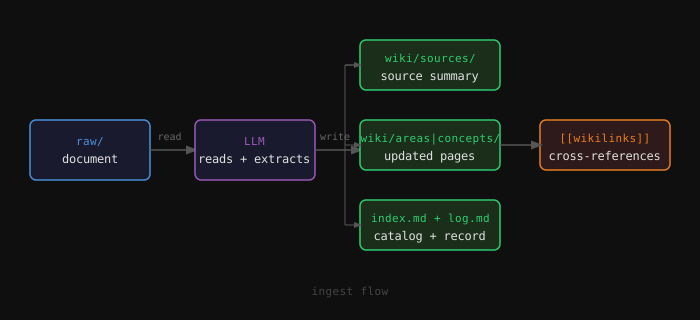
The idea is pretty simple. It follows a three-layer approach where the LLM builds a persistent wiki: you ingest raw documents, and it extracts the key concepts and information to create Markdown files that integrate within the wiki.
What I Use It For and How It Works
Since most of my Notion notes were career-related, my wiki is mostly built around computer science concepts — system design, data structures, and the stuff that actually comes up in interviews. I also use it to track applications and, more importantly, the feedback I get from each process. The next time I'm prepping for an interview, the LLM can pull up past feedback, cross-reference it with the relevant concepts, and tailor the prep session to my actual weak spots.
For career stuff specifically, my routine is simple. Every week, I write a short summary of what I worked on, what I learned, and anything worth remembering. Those notes go into the raw sources folder and get ingested into the wiki. I'm also setting up a cron job to handle the ingestion automatically, so I don't have to think about it. I just drop the notes in, and the wiki stays up to date on its own.
The Setup: Three Layers
Raw sources — videos, transcripts, blog posts, paper PDFs, articles, etc.
The wiki — a directory of LLM-generated Markdown files: summaries, concept pages, and comparisons.
The schema — a CLAUDE.md that tells the LLM how the wiki is structured, what conventions to follow, and what to do when ingesting a new source.
Example of Ingestion
What the Wiki Looks Like in Practice
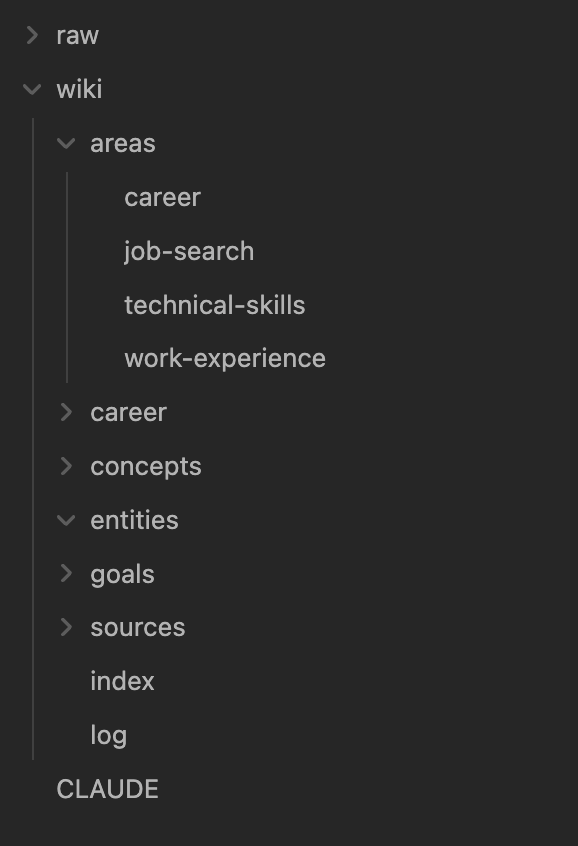
The wiki isn't organized in just one way — it's more of a mix depending on what the content is. Concept pages (system design patterns, data structures, distributed systems topics) are grouped by subject. Interview material is organized by company, with each process getting its own page that covers the rounds, the questions, and the feedback. And some things are just chronological — notes from a course, a book, or a random rabbit hole that I wanted to remember.
In Obsidian, the graph view is where it all comes together. You can see which concepts are heavily linked — messaging systems, for example, ends up connected to pages on Kafka, event-driven architecture, consistency tradeoffs, and a few specific interview experiences where it came up. The orphan nodes are the opposite — things I filed once and never connected, a reminder to either dig deeper or let it go.
The structure isn't perfect, and it doesn't need to be. The point isn't a clean taxonomy; it's that when I need something, the LLM knows where to look — and more often than not, the relevant pages are already linked together.
Here's an example of my wiki at a high level:
Querying: Good Answers Get Filed Back
Querying the wiki is where it starts to feel different from just having good notes. You ask a question, the LLM scans the relevant pages, and it gives you an answer that's already established in your own context — one that references the specific things you've read, the feedback you've logged, and the concepts you've been building up.
But here's the part I didn't expect: the answers themselves are worth keeping. If I ask something like "When does it actually make sense to introduce Kafka over a simpler queue?" and get a solid breakdown back — consumer groups, log retention, the replayability angle — that doesn't need to live and die in a chat session. I file it as a page. Next time that topic comes up in an interview or a system design discussion, it's already there, already in my own words, and already connected to the other distributed systems concepts in the wiki.
It sounds small, but it adds up fast. Every good question you ask makes the wiki a little more useful for the next one.
In Action: The CLI Tool
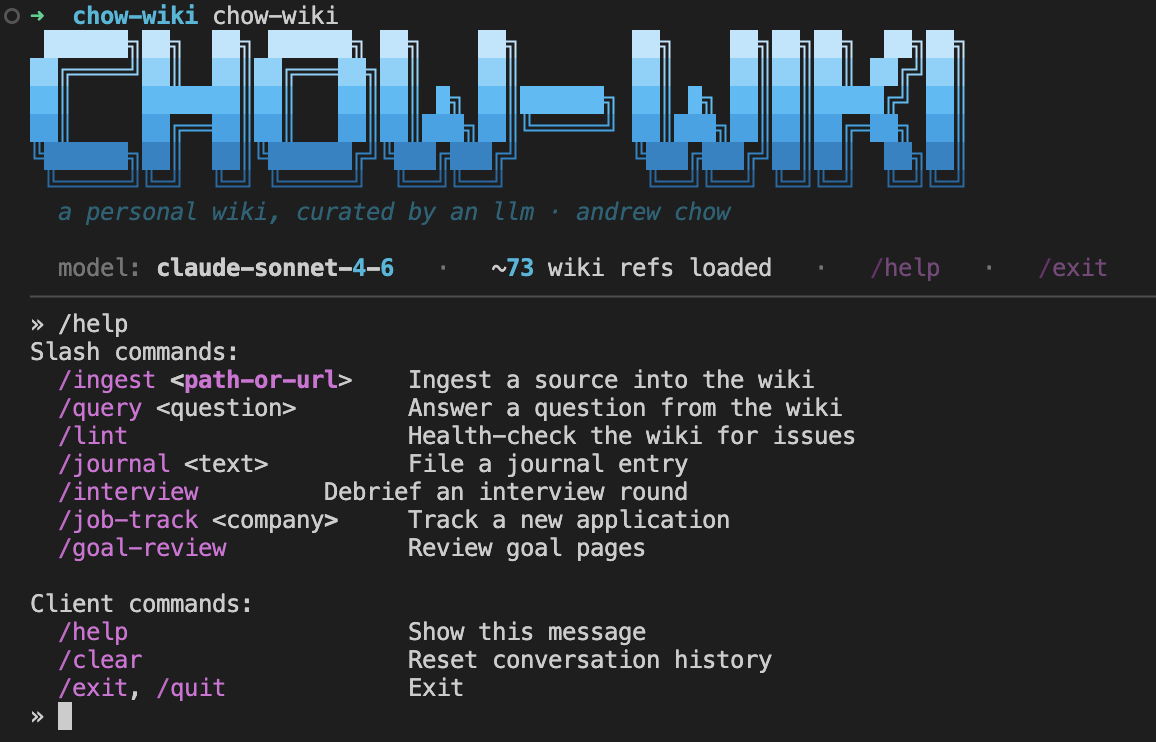
The CLI is a wrapper around the SDK that injects a system prompt on startup, which loads the CLAUDE.md and the wiki index so the model has full context of conversations. Then, using a standard tool-use loop, the agent uses tools to read, write, and fetch data.
Takeaways
I've only been doing this for a little while, but it already feels like the right way to manage knowledge. The big thing for me is that it compounds — every source I add and every question I ask makes the next session a little more useful. That never happened with Notion.
The career progression angle is what I'm most excited to keep building out. Lessons from a job tend to fade once you're onto the next thing. Having a place where that stuff actually sticks, and that I can query later, feels genuinely useful — not just nice to have.
If you spend any real time learning and you're not happy with how you retain it, I'd give this pattern a try.
~ AC